Optimizing piglet performance from the very beginning
The first hours of a piglet’s life set the course for the rest of its life. Ensuring an adequate energy supply during the first few days of life is one of the greatest challenges in pig farming.
An insufficient energy intake has been shown to be one of the main causes of piglet losses in the first 48 hours of life. At the same time, this critical window lays the foundation for the animal’s further development and performance. Against this backdrop, a key question arises in practice: How can energy supply be ensured, and what impact does it have on survival rates and performance?
Why Energy Is So Crucial in the First Few Hours
Newborn piglets have only very limited energy reserves, yet they require approximately 900–950 kJ per kilogram of body weight to meet their energy needs under moderate climatic conditions. Often, however, only a portion of this energy requirement can be met through the piglets’ own energy reserves and colostrum, which can lead to an energy deficit. Weaker animals with low birth weights (<1.2 kg) are particularly affected by this: They already have fewer energy reserves than their littermates and will be further weakened by an energy deficit, which can lead to growth depression or losses. This is where readily available energy sources come into play: They promote piglet activity, support early suckling behavior, and help stabilize colostrum intake.

Energy supplementation in focus
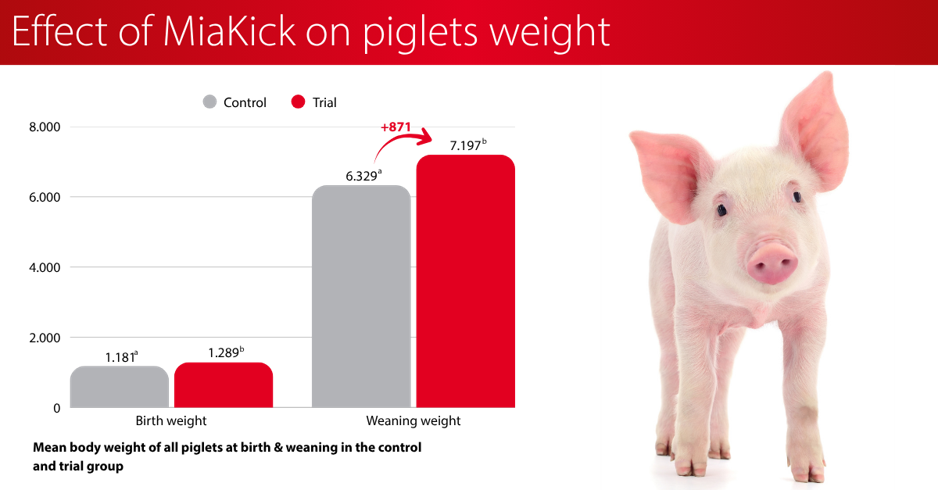
One way to specifically meet the energy needs of newborn piglets is to supplement their diet with MiaKick. In a study involving a total of 444 piglets, the effects of MiaKick supplementation were determined by comparing a control group with a treatment group. Piglets with a birth weight of less than 1.2 kg received 2 ml of MiaKick immediately after birth, while piglets weighing less than 0.9 kg also received an additional dose on their second day of life. The results showed clear advantages of this targeted energy supply: Not only did the treatment group have a higher weaning weight, but there was also a tendency toward improved litter uniformity.
What does this mean in practice?
Looking at the study’s results, one can derive very clear recommendations for practical application. A supplementary energy supply provided by MiaKick can have a positive effect on vitality and, consequently, on colostrum intake and subsequent growth. Piglets with low birth weights, in particular, can benefit from this individualized support, thereby minimizing losses in the first days of life and significantly improving performance. In addition, it can reduce variability within litters. Given the trend toward larger litter sizes and increasing variability within litters, differentiated management during the early stages is therefore becoming increasingly important.
What strategies are you currently using to provide optimal care for weak piglets during their first hours of life?